Showing posts with label social networking. Show all posts

Sunday, May 23, 2010

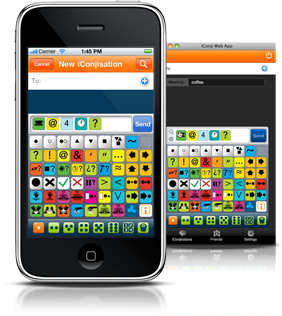
iConji: New language developed for cellphone/social networking


This is their webpage.

iConji is new. It isnt even on wikipedia yet. Details are scarce but this appears to be a new language specifically developed for cellphone texters and social networking junkies. Unlike most current languages, iConji is more like ancient egyptian hieroglyphics or ancient chinese. Its a pictorial language using pictographs. There are > 1000 32x32 pictographs or icons unlike most languages which have one symbol per phoneme or sound.Each icon represents an object or idea.

This appears to have been designed to be cellphone friendly, in this case, an iphone which uses a touch screen and your fingers as the writing device. You can make a message with only a few icons so its much faster. Another advantage is that it is language agnostic, i.e. you can easily communicate with people who speak different languages + its easier for machine translation.


Safety signs and traffic signs serve the same purpose.  They are also pictograms and they can be understood by people who speak different languages.

Personally I doubt this will catch on except if it is fully automated. As the chinese alphabet shows, you need a heck of a large number of icons to represent all possible ideas and words in daily life.

Saturday, May 1, 2010

I'm on Facebook

I finally have a facebook account. I'm linking it to my blog via feeds.

I have no idea what I'm doing , but i'll learn!

Friday, April 30, 2010

Facebook's Eroding Privacy Policy

This article shows the different privacy policies of facebook. You can see as it slowly changes over time, getting worse and worse.

A lot of people either blissfully are ignorant of this or dont care since facebook provides something in return like say - convenience. Thats a wrong attitude since losing your privacy has very real consequences
in reference to:
"Since its incorporation just over five years ago, Facebook has undergone a remarkable transformation. When it started, it was a private space for communication with a group of your choice. Soon, it transformed into a platform where much of your information is public by default. Today, it has become a platform where you have no choice but to make certain information public, and this public information may be shared by Facebook with its partner websites and used to target ads."

Viewed together, the successive policies tell a clear story. Facebook originally earned its core base of users by offering them simple and powerful controls over their personal information. As Facebook grew larger and became more important, it could have chosen to maintain or improve those controls. Instead, it's slowly but surely helped itself — and its advertising and business partners — to more and more of its users' information, while limiting the users' options to control their own information.
- Facebook's Eroding Privacy Policy: A Timeline | Electronic Frontier Foundation (view on Google Sidewiki)

Sunday, March 28, 2010

BBC: the virtual revolution caused by the internet


An excellent series of BBC TV reports about the impact of the internet. I like the part about the generation gap caused by growing up with the net, how it makes you think differently. After all the arguments I have with my stuck in the 60's parents, I believe it.

NOTE: not all episodes are here

Part One: The Great Levelling

In the first in this four-part series, Aleks charts the extraordinary rise of blogs, Wikipedia and YouTube.
She also traces an ongoing clash between the freedom the technology offers us, and our innate human desire to control and profit.


Part Two: Enemy Of The State

Aleks charts how the Web is forging a new brand of politics, both in democracies and authoritarian regimes.
With contributions from Al Gore, Martha Lane Fox, Stephen Fry and Bill Gates, the programme explores how interactive, unmediated sites like Twitter and YouTube have encouraged direct action and politicised young people in unprecedented numbers.
Yet, at the same time, the Web's openness enables hardline states to spy and censor, and extremists to threaten with networks of hate and crippling cyber attacks.


Part Three: The Cost Of Free


Aleks gives the lowdown on how, for better and for worse, commerce has colonised the web - and reveals how web users are paying for what appear to be 'free' sites and services in hidden ways.
Joined by some of the most influential business leaders of today's web - including Jeff Bezos (CEO of Amazon), Eric Schmidt (CEO of Google), Chad Hurley (CEO of YouTube) and Bill Gates, the programme traces how business - with varying degrees of success - has attempted to make money on the web.
She tells the inside story of the gold rush years of the dotcom bubble, and reveals how retailers such as Amazon learned the lessons.
The programme also charts how, out of the ashes, Google forged the business model that has come to dominate today's web, offering a plethora of highly attractive, overtly free web services - including search, maps and video - that are in fact funded through a sophisticated and highly lucrative advertising system which trades on what we users look for.


in reference to: BBC World Service - Programmes - The Virtual Revolution: How and when to listen (view on Google Sidewiki)

Monday, December 21, 2009

Social networking 101 for physicians: friendster, facebook, blog tips

A very nice guide for docs to avoid mistakes

Social networking 101 for physicians

Managing the risks of Facebook, Twitter and other social media

By Eric T. Berkman

October 19, 2009
The usefulness of online social networking is undeniable and it’s no surprise that physicians are embracing it.
But lawyers and other experts warn that these tools present a minefield of legal and professional hazards for medical professionals who don’t take the utmost care in how, what and where they post.
“If you can’t do something at a cocktail party without people staring and looking at you strangely, you shouldn’t be able to do the same thing online,” says Jim Tobin, president of Ignite Social Media, a Cary, N.C., social-media agency that is developing a social-networking program for the Massachusetts Medical Society and its members.
Physicians are using these tools to discuss medical news, pick other doctors’ brains about clinical or practice-management issues, market their practices or just generally feel connected.
In June, MMS polled approximately 800 of its members and found that the usage of social media grew 50 percent in the last year, with usage by doctors aged 45 to 54 tripling.
Whether blogging, participating in open networks like Facebook and Twitter, or visiting physician-only networks such as Sermo or iMedExchange, physicians can reduce their legal risk by doing the following:
  • Be mindful of patient confidentiality.
Online networking presents a risk of a doctor compromising patient information and facing a compliance action under the Health Insurance Portability and Accountability Act (HIPAA) or a lawsuit.
Take, for example, a physician who shares a detailed anecdote about a patient on his or her personal Facebook page, or on Sermo.
The information a physician shares “needs to be generic enough that nobody can identify a patient in the course of reading a post,” says David Harlow, a Newton lawyer and health care consultant who writes the blog HealthBlawg.
Though this sounds like common sense, the potential for carelessness is always present, says Kevin Pho, an internist in Nashua, N.H., whose 5-year-old blog, KevinMD.com, is one of the most popular health care blogs on the Internet, currently boasting more than 26,000 RSS subscribers.
“The easier it is to publish something, like a [Facebook] status update or a [tweet], the easier it is to slip up and give identifying information,” says Pho, who has more than 500 Facebook fans and 14,000 followers on Twitter, a “microblogging” site where users can post 140 character “tweets” on issues of interest.
Daniel Palestrant, the Cambridge-based founder and CEO of Sermo, says the same is true for doctors posting on his site.
“Though Sermo is a secure site and we make every effort to keep information in the community, there may be situations where information is cut and pasted out or someone is motivated to pull information out of the community in one way or another,” says Palestrant, himself a physician.
Confidentiality issues may also arise when doctors allow patients to post on their websites or Facebook pages. A patient might be too open in a “wall” post and later realize he’s made his own information public. He might then blame - and perhaps sue - the doctor.
“Once a patient posts, [he or she has] essentially consented that it be public, but most [patients] won’t view it that way,” says Harlow.
There’s no guarantee such a case would hold up in court. But to be safe, Harlow advises doctors to block patient access to their personal Facebook pages, and provide clear warnings on any public sites against posting medical information.
  • Remember that your patients are not your ‘friends.’
A physician who gets too close to his patients puts himself at risk.
That’s why Cambridge internist Phoebe Cushman refuses to accept Facebook “friend” requests from current or former patients.
“I just hit ‘ignore.’ …  I think it’s very important to have boundaries in the physician-patient relationship,” says Cushman, who also maintains the strictest privacy settings on her account.
That’s a good approach, says Harlow, suggesting that doctors set up a separate page representing their practice and enabling patients to become “fans.”
“This is a way of connecting and allowing folks to follow your updates without blurring that personal/professional line,” he says.
  • Monitor your web presence regularly.
Harlow points out that the pervasiveness of social networking has resulted in some people transmitting all their communication through Facebook and Twitter and expecting others to be there to receive their messages.
Doctors who enable such communication without properly monitoring their sites run the risk of missing urgent messages or a patient’s medical history details and possibly facing a malpractice action for failing to respond, he says.
While social media is obviously not a reliable means of clinical communication with a doctor, it’s hard to tell where a jury’s sympathies might lie.
“There are now more than 300 million Facebook accounts,” says Harlow. “Do you run the risk of going to trial and facing a jury full of people who rely on Facebook as their primary means of communication? They might say someone should have been monitoring the account.”
David S. Szabo, a partner at Edwards, Angell, Palmer & Dodge in Boston, agrees.
“If you start using [social media] as a means of regular communication or an element in how you communicate with people, perhaps you could be charged with at least looking at it on a reasonably regular basis and being aware of information sent that way,” he says.
  • Take advice from online doctors’ forums with a grain of salt.
Physician-only discussion boards like Sermo have become a valuable replacement for the traditional “curbside consult” with colleagues about complex cases.
But Harlow warns that free advice is “worth what you pay for it” and thus “should be taken with a grain of salt.” After all, relying on advice outside the standard of care could constitute malpractice.
Also, since all users post under pseudonyms, “you have to be confident that whoever’s replying [to your inquiry] is who they say they are,” says Pho.
Palestrant reiterates Sermo’s extensive physician verification process, adding that when a user clicks on another member’s profile, he or she can see the member’s specialty, the history of his activity on the site, and his rating by fellow users.
Nonetheless, Palestrant adds, physicians should of course solicit information from multiple sources, such as journals, peers, or non-physician colleagues such as nurses and physician’s assistants.
  • Be aware that you’re never truly anonymous on the web.
In 2007, a Boston-area pediatrician, known as “Dr. Flea,” blogged about his ongoing med-mal defense, sharing candid musings on defense strategy, the jury, opposing counsel and the plaintiff’s case.
He thought everything was safely cloaked in anonymity until his cross-examination at trial, when plaintiff’s counsel - who had been following the blog and noting similarities - outed him to the jury. The case settled the next day.
Szabo says this is a cautionary tale that anything posted on the web can be traced back, with severe consequences.
“When you start throwing in little details, if you have any connection to someone, it may not be too tough for that person to figure out who you are,” he says.
Pho adds that anything you write on Twitter or your blog is indexed by Google and kept permanently.
“So never write anything disparaging about your hospital, patients or other doctors, because it can be found,” he says.
Further, Szabo warns that Internet service providers, websites and social-networking companies are under no obligation to resist subpoenas in a civil lawsuit. Accordingly, they might decide to produce information like an IP address or e-mail address that could identify the name of a person who posted offending content.
Finally, says Tobin, the existence of vehicles like Facebook and Twitter does not change existing copyright, slander and libel laws.
“We’re under the same restrictions we’ve always been under,” he says. “The only difference is that saying something is much easier. You can send a tweet or a Facebook status update in seconds. So you need to pause and think before you hit that ‘update’ button.”


in reference to:
"Social networking 101 for physicians"
- Social networking 101 for physicians : Mass Medical Law Report (view on Google Sidewiki)

projectwonderful adszz

Nuffnag Adzz

Slashdot It

Followers